

Becoming a spiritual therapist: journey, stance of a guide and vibrational therapy in practice.
Summary
Introduction
Becoming a spiritual therapist is almost never a youthful ambition. It's a turning point that occurs midway through a journey, often after a personal experience that has shifted one's perspective. The International Academy of the Quantum Creator welcomes individuals from engineering, healthcare, education, or business who seek to give professional form to their inner experiences.
The word "therapist," however, deserves to be used with precision. In an unregulated field, it designates no protected title but rather a stance: that of a trained guide who maintains a framework, knows their limits, and works with the energetic field of the person being treated. It is this stance that the curriculum builds, module by module, far more than a mere collection of techniques.
One point must be made clear from the outset. When the Academy speaks of quantum therapy or vibrational coherence, it is referring to an energetic and spiritual approach inspired by biophysics, with its concepts of field, biophotons, and coherence. It is never referring to scientific quantum technologies such as quantum computing, qubit analysis, or cryptography. The vocabulary is shared, but the objects are radically different.
This article describes the concrete path to becoming a spiritual therapist: what the profession entails, how the training is structured, what role vibrational therapy plays, and what the first months of practice in a clinic are like.
Becoming a spiritual therapist: what the profession entails
Spirituality here refers to a person's relationship with that which transcends them and with the meaning they give to their existence. A spiritual therapist does not deliver a doctrine; they accompany someone in their own exploration, using specific tools and skilled listening.
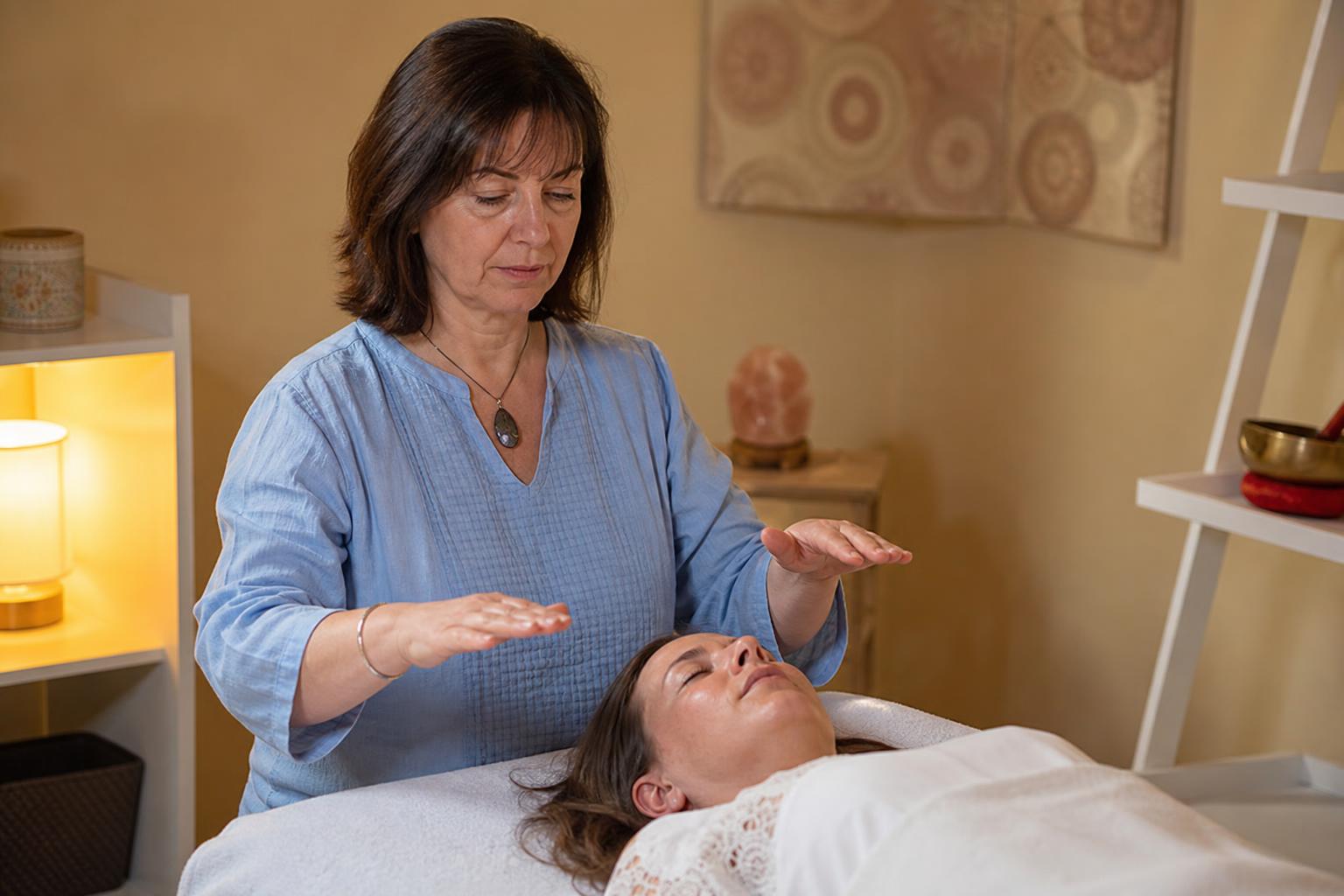
In practice, a session combines dialogue, work on feelings, reading the energy field, and suggestions for practices to continue between appointments. Guided meditation, breathing exercises, grounding, writing, chakra balancing: each practitioner creates their own approach based on their experience.
The difference between a practitioner and a purely energy-based practitioner lies in their approach. The energy practitioner starts with the body and its tensions; the spiritual therapist starts with meaning, the repetition of a life pattern, a quest searching for its words. The two quickly converge, because the body retains the memory of what consciousness has not yet formulated .
The table below shows the relationship between the two approaches. They are not mutually exclusive: many practitioners trained at the Academy use both, depending on what the client is seeking.
Criteria | Energy Practitioner | Spirituality Therapist |
Front door | The body and its tensions | The meaning and path of life |
Central tool | Energy healing protocol | Guidance, dialogue, and work on awareness |
Usual duration | One-off sessions or short series | Progress tracked over several months |
Required training | Protocols, feelings, subtle anatomy | Protocols and work of personal transformation |
Ethical framework | Complementary to medical monitoring | Complementary to medical and psychological follow-up |
An important point for anyone wanting to become a spiritual therapist: neither of these approaches constitutes medical treatment. They provide support, they harmonize, they contribute to well-being, and they stop where diagnosis begins.
This leads to a career change towards spiritual guidance.
The motivations are similar from one journey to another. First, there's the lived experience: a difficult period overcome thanks to energy healing, and the desire to share what worked. This gratitude is a powerful driving force, provided it has been filtered through the training process.
Then comes the weariness of a job that no longer holds meaning. Managers, caregivers, and salespeople describe the same feeling: that of being competent in a role that no longer resonates with them. Spiritual guidance offers them a space where coherence between who they are and what they do becomes possible again.
A third, more subtle motivation relates to the awakening of consciousness. Some people have inner experiences that they can neither name nor locate. They seek a solid conceptual framework as much as a profession, and the training provides them first with a vocabulary before it provides them with a clientele.
None of these reasons alone is sufficient. What distinguishes a solid project from a passing fancy is real availability: time to study, consistency to practice, and a clear-eyed acceptance of the fact that the installation is built slowly.
The training path to becoming a spiritual therapist
The Academy's curriculum rests on three interconnected pillars: a conceptual foundation, supervised practice, and personal transformation work. Removing any one of these three inevitably results in an unbalanced mentor, either too theoretical, too technical, or too emotionally involved.
The conceptual foundation and the correct vocabulary
The first step is to put precise words to subtle realities. Aura, chakras, subtle bodies, cellular memory, vibrational coherence: these concepts circulate widely and often incorrectly. The introductory module defines them, connects them, and shows what biophysics allows us to say about them—and what it does not.
This rigor in language is not an academic refinement. It is protective. A facilitator who knows how to name precisely what they observe will never promise what they cannot deliver , and will be able to explain their work to a skeptical person without hiding behind mystery.
The practice workshop and guided rehearsal
Next comes the hands-on aspect. Perceiving an energy field, identifying an area of density, following the evolution of a sensation during a session: these skills are built through repetition, never through reading. The workshops alternate between paired exercises, feedback from the tutor, and case studies.
The pace remains customizable. The online platform allows participants to progress module by module from home, while the immersion days and anchoring weekends offer the intensive experience of in-person sessions to those who can travel. The two formats complement each other rather than compete.
The transformative work of the future therapist
This is the most demanding and often underestimated pillar. You can't accompany someone further than you yourself have gone. The program therefore requires continuous personal work: reviewing one's history, releasing limiting beliefs, regular meditation practice, and supervision of initial coaching experiences.
This path has a direct effect on the quality of presence during sessions. A calm practitioner maintains a stable space; a practitioner who projects their own wounds disrupts the work of the person being treated. To become a spiritual therapist, the first training ground remains oneself .
Vibrational therapy in the training of the future therapist
Vibrational therapy forms the technical core of the curriculum. It is based on a simple working hypothesis: living beings are not just biochemical mechanisms, they are also a set of interacting frequencies, the coherence of which degrades under the effect of stress, shock or the repetition of a scenario.
We detailed the structure of a session and the posture it requires in our article dedicated to vibrational therapy training . For those wishing to become spiritual therapists, the benefit lies elsewhere: the vibrational dimension provides concrete support for work that, without it, would remain purely verbal.
What a vibrational protocol actually works on
A vibrational protocol begins with a reading of the field, continues with harmonization work zone by zone, and concludes with grounding. In between, the practitioner modulates their intention, adjusts their distance, and observes the body's reactions: breathing, micromovements, heat, relaxation.
The concepts of biophotons and field coherence serve as a framework for this work. They do not prove anything on their own, and the curriculum clearly states this: they are models that help to conceptualize the practice, not scientific demonstrations of its effectiveness.
Vibrational coherence and inner posture of the guide
Vibrational work operates in both directions. The practitioner's inner state is part of the process: a scattered, tired person, or one overwhelmed by their own concerns, struggles to maintain the space. Therefore, the training incorporates centering routines before the session and energy clearing afterward.
This is one of the points where the vibrational dimension intersects with the spiritual aspect of the profession. Raising one's vibration is not a slogan: it describes a patient process of inner clarification, the effects of which students experience first in their daily lives, then in their practice.
A caveat is necessary, and it applies to the entire course. Vibrational healing accompanies, harmonizes, and promotes relaxation ; it does not treat or cure any pathology, and never replaces medical care. Each student learns to say this to their future clients.
The EVOCQ® method: auric purification and limiting memories
EVOCQ® is the Academy's exclusive method. It articulates three movements: the purification of the auric field, the release of limiting memories and the reconnection to what the method calls the original vibration, that is to say the state of coherence specific to each person before the accumulation of imprints.
The concept of limiting memory encompasses these patterns that replay themselves despite the person's lucidity: the same relational configuration, the same blockage when it comes to committing, the same fatigue when faced with an opportunity. The EVOCQ® protocol seeks to deactivate this pattern rather than provide yet another explanation.
For a future spiritual therapist, this method offers a guiding thread where many practitioners simply juxtapose techniques learned separately. The coherence of the protocol ensures the coherence of the support provided , and this is what clients perceive first.
The method is learned in order, without shortcuts. Each step presupposes the previous one, and certification does not validate the memorization of a sequence but the ability to adapt it to a real situation, under supervision.
SOLARIS: Practitioner of Vibrational Ascension Technologies
SOLARIS is the Academy's flagship training program. It trains practitioners of vibrational ascension technologies and the Intelligence of Light, based on a deliberate articulation between biophysical reading of living beings, energetic practice and spiritual path.
Its structure is based on long-term support. Theoretical modules are available online, accompanied by printable manuals, bibliographies for those who wish to delve deeper, and downloadable meditations. Each student progresses at their own pace, with a tutor available and a forum for discussion among students.
The curriculum also includes an initiatory journey, an immersive experience where learning moves from theory to practice. Many students see this as the turning point in their journey: the shift from knowledge that is understood to knowledge that is truly embodied.
SOLARIS is designed for both beginners and established practitioners looking to structure their intuitive practice. For those aiming to set up their own practice, long-term support remains the key advantage.
Setting up a private practice: framework, pace and initial support
Setting up a practice rarely begins with a private office. It starts with offering a few sessions to close friends and family, then building a first circle of clients who spread the word by mouth. This discreet phase allows the practitioner to refine their approach without the pressure of a full schedule.
The space matters more than you might think. A dedicated, quiet room, kept energetically clean, has a measurable effect on the quality of sessions. Many practitioners start out at home, while others rent a slot in a shared space with complementary professions.
Choosing between in-person and remote support
Remote work has become a fully-fledged method, including for energy work. It broadens the recruitment area, is suitable for people with disabilities, and allows for more regular follow-up. In-person sessions retain the advantage of physical presence, which is invaluable during initial sessions and sensitive stages.
Most practitioners trained at the Academy alternate between the two. A first session in person when possible, then remote follow-up interspersed with physical appointments: the format follows the person's needs, never the other way around .
The question of pace remains. Serious spiritual guidance requires energy and recovery. Three to five sessions per day constitute a realistic limit for most practitioners, and students learn early on to protect this threshold rather than push it.
Ethics: the limits that a spiritual guide must respect
Professional ethics is not a chapter added at the end of training; it permeates the entire curriculum. The energetic and spiritual approach is complementary and in no way replaces conventional medical care. In the event of any organic symptom, unusual sign, or worsening condition, the practitioner will refer the patient to a doctor immediately and without question.
The same rule applies to mental health. Severe distress, detachment from reality, and dark thoughts: these situations require the expertise of professionals trained to handle them. Knowing when not to provide support is part of the job, and probably the most difficult skill to acquire.
A caregiver never asks for treatment to be stopped, makes any diagnosis, or announces any results. They also do not interpret a person's medical tests. These guidelines are fixed, and the curriculum revisits them in each practical module.
Words that commit, words that protect
Vocabulary makes up half the picture. Curing, treating, or healing an illness: these verbs have no place in the mouth of a spiritual therapist. Accompanying, harmonizing, contributing to well-being, and promoting relaxation: these describe exactly what happens in a session.
This clarity protects the patient, who will not forgo necessary care based solely on a promise. It also protects the practitioner, whose credibility depends on the accuracy of their statements. Honest guidance is better than a promise that cannot be kept .
One final point worth repeating: the quantum therapy discussed here falls under the umbrella of energy work and spirituality. It has no connection whatsoever with scientific quantum technologies, quantum computing, or qubit-based calculations, with which it shares only an adjective.
They share their experiences
Student feedback often sheds more light than a brochure. Joëlle, a chemical engineer and mosaic artist, followed the first two modules of the SOLARIS training with the demanding eye of a scientist.
“I tested the first two modules of the SOLARIS Training. It’s a dense and very rich course, unique in its connection between science, spirituality, and energy. As a chemical engineer and mosaic artist by training, this approach particularly interested me. What’s so enriching, and in fact its real strength, is the link between this and energy work, and with living things. It’s a powerful transmission, delivered with heart, very pleasant to read and absorb. Everything is sourced for those who wish to delve deeper on their own.”
— Joëlle T., chemical engineer and mosaic artist, SOLARIS training modules 1 and 2. Google review.
Frequently asked questions about becoming a spiritual therapist
Do you need a recognized diploma to become a spiritual therapist?
No, the profession is not governed by any protected title and there is no state-recognized diploma in this field. It is precisely for this reason that the quality of training, the depth of personal work, and the clarity of the ethical framework make all the difference between a qualified coach and an improvised practitioner.
How long does the training take?
The SOLARIS program unfolds over two years of support, allowing ample time to assimilate the content, practice, and develop personally. Some students begin receiving clients at the end of the first year, under supervision; others prefer to wait until they have completed the entire program.
Is it possible to train while maintaining one's current job?
Yes, and that's the case for the majority of students retraining for a new career. The theoretical modules are accessible online and can be completed at each student's own pace, group sessions are scheduled in advance, and immersion days are concentrated on a few specific dates. The professional transition is gradual.
Can vibration therapy replace medical supervision?
No, absolutely not. This is a complementary approach that harmonizes the energy field and contributes to well-being; it does not treat or cure any illness. Anyone experiencing an organic symptom should consult a doctor, and any ongoing treatment should not be interrupted.
Is it necessary to already have a spiritual practice before entering training?
This is not a prerequisite. Genuine curiosity and inner openness are enough to get started. Regular practice—meditation, grounding, self-observation—is established during the course and quickly becomes the daily foundation of the facilitator.
How can I know if this path is really right for me?
The introductory interview serves precisely this purpose. It allows you to compare your intentions with the realities of the profession, assess your availability, and ensure that the Academy's approach aligns with your perspective. An hour of clear discussion is far better than a rushed enrollment.
Book a discovery interview
The best way to know if this path is right for you is through direct conversation. Becoming a spiritual therapist requires time, energy, and a degree of intimacy: it's best to discuss this before committing.
The initial consultation is free and without obligation. It allows us to clarify your starting point, your intentions, and the format that would suit you best, and then to verify together that the Academy's approach aligns with your needs. The detailed curriculum and its terms are presented during this consultation.


