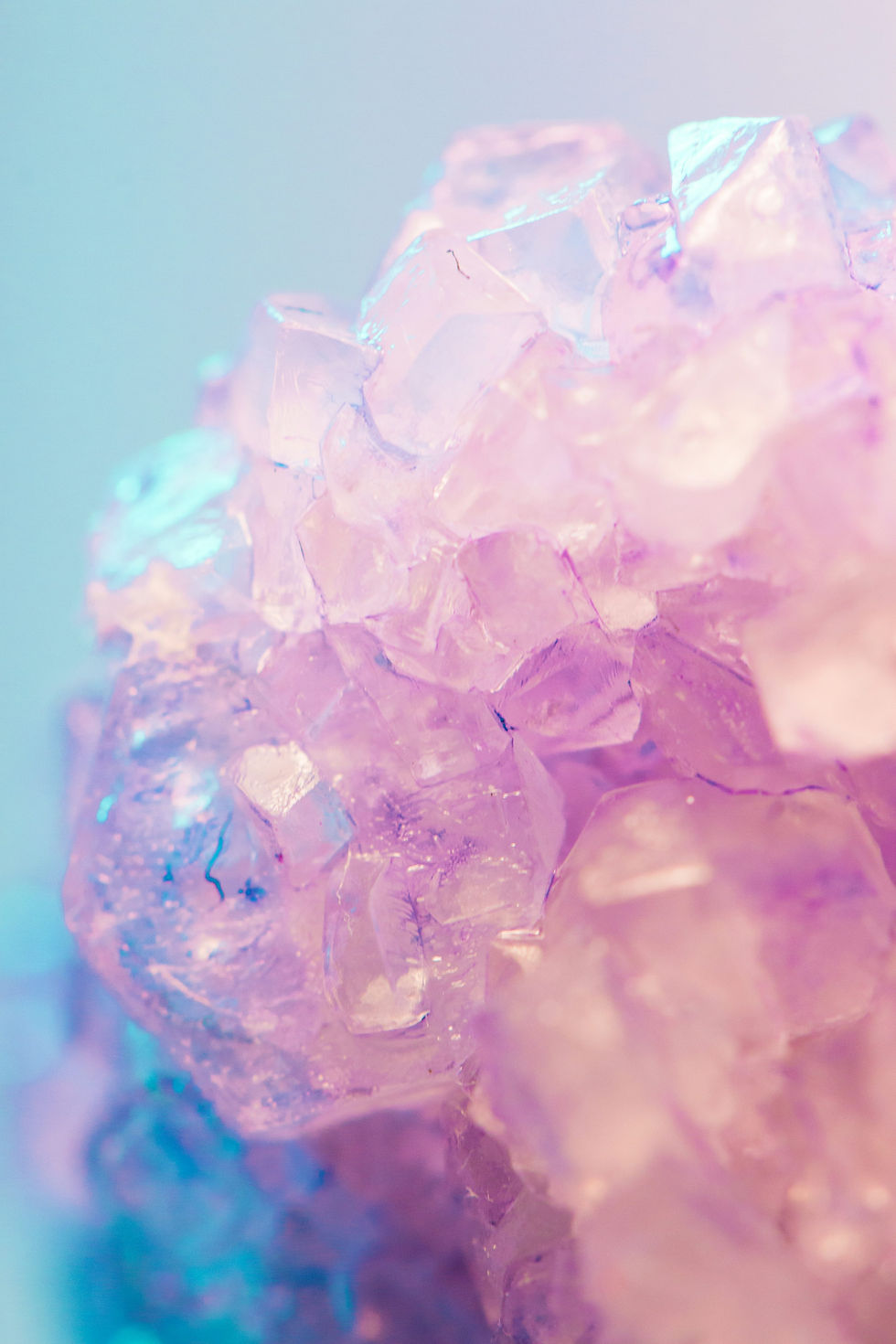
How do crystals work scientifically: the science behind crystal healing energy
Table of Contents
How crystals work scientifically at the molecular level
Do crystals have energy and give off real vibrations
How the science behind crystals and energy actually works
Frequently asked questions
This article answers how crystals work scientifically by walking you through the verified physics of crystal structure, the piezoelectric effect, and what peer-reviewed research actually confirms about crystal energy science and healing claims.
How crystals work scientifically at the molecular level
Every crystal begins with order. Over geological time, atoms settle into a repeating crystal lattice: stable, measurable, and central to any serious theory about the science of crystals.
The piezoelectric effect: a measurable crystal property
Once grounded in that crystal structure, you can see where the phenomenon becomes testable. In 1880, Pierre and Jacques Curie showed that certain crystals, including quartz, generate an electrical response under mechanical stress or heat.
Pressure-to-charge conversion: When stress is applied to a quartz crystal, its crystal lattice shifts slightly out of symmetry. That deformation produces a small but measurable electrical output.
Thermal sensitivity: Changes in temperature alter atomic spacing within the lattice, which can also displace charge centers and generate voltage. It is related to piezoelectric behavior, but not identical in mechanism.
Magnitude context: In practice, the energy involved is very small. It remains far below established medical technologies such as TENS, EMS, or radiofrequency ablation.
From there, crystals work in technology because these properties are dependable. Quartz crystal components regulate timing in watches, radios, and medical ultrasound systems through stable electrical behavior and a highly repeatable frequency.
Crystal vibrations science and atomic structure
That same principle extends to crystal vibrations science. At the vibrational level, atoms in any solid are always moving, and a mineral’s frequency depends on its composition, crystal structure, and lattice geometry rather than symbolism.
Once those oscillations are controlled and measured, quartz supports accurate timekeeping and a range of electrical applications.
From laboratory to technology: crystals that work
Moving into applied physics, the material's value depends on how thoroughly its properties have been characterized and calibrated. Crystals work in inkjet printers, implants, and ultrasound devices because their energetic properties can be calibrated within exact tolerances.
This does not confirm every claim made about crystal energy, stress relief, or healing. You can consult a practical chakra stones guide to explore how these principles intersect with intentional practice.
Do crystals have energy and give off real vibrations
Two questions return again and again in this work: do crystals actually carry energy, and does that energy interact with human beings in any measurable way? Both questions have partial scientific answers, and the line between measurable fact and spiritual interpretation is where the real work begins.
Atomic vibration: what science actually measures
At the atomic level, all matter moves through thermal motion, which means crystals vibrate. That vibrational activity can be measured in laboratory conditions with spectroscopic instruments.
A crystal’s frequency depends on its mineral composition, size, and internal lattice structure. That stability contrasts with the human body, which shifts constantly: temperature, environment, and emotional state all alter its vibrational patterns.
Quartz offers a concrete example: its ordered lattice allows a stable oscillation frequency, which is why it is used in timekeeping, ultrasound, and microphones. This is scientific evidence tied to observable properties, not proof that a crystal interacts therapeutically with a person’s energy field.
Crystal type | Known measurable property | Verified application |
Quartz | Stable oscillation frequency | Timekeeping, ultrasound, microphones |
Piezoelectric minerals | Electrical charge under pressure | Medical implants, inkjet printers |
Shungite | Contains carbon and heavy metals | Requires cautious handling, toxicity risk |
Colored crystals | Light absorption at specific wavelengths | Optical instruments, decorative use |
Vibrational frequency theory vs. scientific evidence
Once grounded in what can be measured, the next distinction matters. According to Einstein’s mass-energy equivalence, all matter contains energy, so a crystal does contain energy in that physical sense.
What has not been established is something more specific: no controlled study has produced evidence of measurable energy transfer between crystals and the human body in a therapeutic or medical setting. Belief, symbolism, and lived experience are not the same as laboratory proof, and that distinction deserves to be held clearly rather than collapsed.
Vibrational frequency theory proposes that crystals vibrate in ways that affect the human energy field. That framework is spiritual in nature: the human energy field it references has no confirmed existence in measurable physics, which places the claim as unverified rather than disproven, a meaningful difference.
As the practice deepens, you can hold both truths carefully: crystals have measurable properties, some produce an electrical response under pressure, and some applications are well established. In practice, the difference lies in how deeply you distinguish physical behavior from spiritual meaning.
How the science behind crystals and energy actually works
Once grounded in the physics, the question changes. The science behind crystals and their effects on people can be discussed clearly, yet the current evidence points to a psychological mechanism rather than an energetic one, and that difference matters in practice.
What peer-reviewed research says about crystal healing
From there, the strongest claims must pass through research. The science behind crystals and energy was tested in a well-known study by Christopher C. French at the University of London between 1999 and 2001, comparing real crystals with convincing fakes, and participants reported the same kinds of effects in both groups.
No measurable difference: Reported sensations were statistically identical whether participants held genuine quartz or a plastic replica, which means the object itself did not account for the response.
Belief as the variable: Participants who already believed in crystal healing were about twice as likely to report effects, regardless of which object they held, pointing to expectation as the active factor.
Classification outcome: Based on this and similar studies, crystal healing is classified as pseudoscience, and no National Science Foundation-supported evidence that crystal healing works beyond the placebo effect has been identified.
That finding also helps explain why anecdotal evidence remains persuasive. As the practice deepens in community settings, confirmation bias shapes memory and interpretation: people tend to retain experiences that support what they already believe, a documented phenomenon that can sustain conviction without demonstrating crystal energy as a physical force.
Placebo, intention, and the psychology of crystals
The reported benefits can still be understood with precision. The crystal healing placebo effect works through focused attention, ritual, and expectation, and those processes can influence mood, perception, and stress in measurable ways over time.
The shift happens when you stop asking whether a stone emits special power and start noticing what attention is doing. When you hold a crystal with intention, you create a structured pause: the mind settles around the act, and that response is psychologically real even when scientific evidence does not show a unique energetic mechanism.
From there, The International Academy of the Quantum Creator recognizes this boundary with care. When crystals are used during meditation, any relief of stress or anxiety reflected in studies is attributed by the available evidence to the meditative practice itself, not to the crystal, even if the ritual object helps you remain present.
How to work with crystals responsibly alongside science
In contrast, you can honor symbolism and personal meaning while staying aligned with scientific evidence, and that alignment is worth maintaining deliberately.
Complement, do not replace: Crystals should never replace medical care or medical treatment for diagnosable conditions such as anxiety, depression, or other disorders; The International Academy of the Quantum Creator holds that boundary clearly.
Use crystals as anchors: A crystal can serve as a focus point during meditation or reflection, and that use fits what studies of attention, ritual behavior, and placebo response already show.
Handle with awareness: Some minerals carry physical risks, and their material properties matter: shungite and certain others may contain heavy metals, so extended skin contact calls for caution.
Distinguish meanings of energy: In science, energy has a precise definition; in spiritual language, crystal energy refers to something else entirely, and keeping those meanings separate protects clarity.
Once grounded in that clarity, you can work with crystals for reflection, mindfulness, and intention while recognizing that the science behind crystals and energy, and the broader body of research, do not provide medical evidence that crystal healing has effects beyond placebo.
Frequently asked questions
Is there any scientific evidence that crystals work?
There is scientific evidence that crystals work in technology. A quartz crystal is used in oscillators, ultrasound devices, and some medical applications because of measurable properties such as piezoelectric response and stable vibrational behavior.
For crystal healing, the picture is different. Peer-reviewed studies and broader research, including a study by Christopher French, found no healing effect beyond the placebo effect, and the current evidence in the scientific literature does not support the claim that crystals work therapeutically.
Do crystals actually vibrate, and does that affect humans?
Yes, crystals vibrate. At the atomic level, matter is always in motion, and quartz is no exception: a quartz crystal can maintain a precise, measurable frequency.
While vibrational theory proposes that crystal frequency can influence human well-being, no controlled scientific study or body of research has produced evidence that this interaction occurs in a therapeutic way.
Can crystals be used alongside conventional medical care?
Some medical professionals accept crystal healing as a personal ritual. The stress reduction it may bring is linked to relaxation, focused attention, and expectation: mechanisms closely related to the placebo effect.
The International Academy of the Quantum Creator maintains a clear boundary: crystals should not replace diagnosis, treatment, or any other form of conventional medical care. Once grounded in that understanding, crystals can still support reflective work, meditation, and personal meaning within a complementary, non-clinical setting.